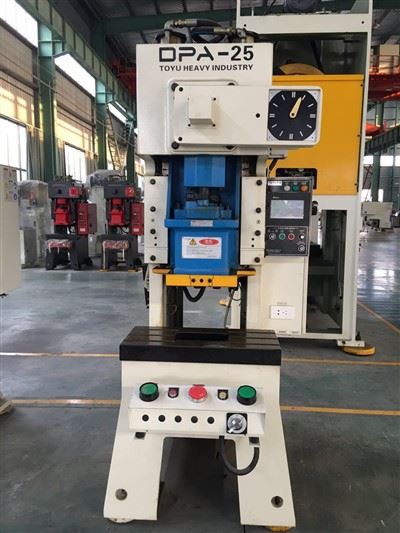

Features
1. Wide application range: High precision steel frame punching machines can be used for various metal processing applications, including cutting, bending, punching, stamping, and embossing. This versatility makes it an excellent investment for any industrial application.
2. Easy to operate: Closed single handle high-precision steel frame punch press, easy to operate, intuitive control, and simple adjustment. This makes it suitable for operators with a range of skill levels, thereby reducing the need for extensive training.
3. Enhance safety: The high-precision steel frame punch design has safety functions that can protect operators from accidents and injuries. This includes safety covers and protective devices, emergency stop buttons, and interlock switches.


Application scope
|
Name |
Unit |
DPS-125T |
DPS-160T |
DPS-200T |
|||
|
Nominal force |
KN |
1250 |
1600 |
2000 |
|||
|
Type |
V |
H |
V |
H |
V |
H |
|
|
Slider stroke |
mm |
250 |
160 |
280 |
180 |
300 |
200 |
|
Nominal force stroke |
mm |
20 |
15 |
20 |
15 |
25 |
20 |
|
Number of strokes (constant speed) |
s.p.m |
40 |
60 |
35 |
55 |
40 |
50 |
|
Maximum die height |
mm |
400 |
450 |
450 |
500 |
500 |
550 |
|
Die height adjustment |
mm |
100 |
100 |
120 |
|||
|
Lower worktable size |
mm |
750×700×105 |
800×750×115 |
850×800×35 |
|||
|
Slider bottom |
mm |
750×450 |
810×500 |
930×700 |
|||
|
Worktable center hole |
mm |
Ø310 |
Ø350 |
Ø400 |
|||
|
Die handle hole |
mm |
Ø75 |
Ø75 |
Ø75 |
|||
|
Main motor |
KW×P |
11×4 |
18.5×4 |
22×4 |
|||
|
Pulling rod size |
mm |
M30×550 |
M30×620 |
M36×700 |
|||
|
Air pressure used |
MPa |
0.6-0.7 |
0.6-0.7 |
0.6-0.7 |
|||
|
Punch (front and back × left and right × height) |
mm |
1763×1623×3600 |
2090×1906×3900 |
2302×2056×4355 |
|||
|
Name |
Unit |
DPS-250T |
DPS-315T |
DPS-400T |
|||
|
Nominal force |
KN |
2500 |
3150 |
4000 |
|||
|
Type |
V |
H |
V |
H |
V |
H |
|
|
Slider stroke |
mm |
320 |
200 |
350 |
250 |
400 |
250 |
|
Nominal force stroke |
mm |
25 |
20 |
30 |
20 |
30 |
20 |
|
Number of strokes (constant speed) |
s.p.m |
35 |
50 |
28 |
40 |
25 |
35 |
|
Maximum die height |
mm |
520 |
580 |
550 |
600 |
600 |
675 |
|
Die height adjustment |
mm |
120 |
120 |
150 |
|||
|
Lower worktable size |
mm |
950×900×155 |
1000×900×177 |
1200×1000×185 |
|||
|
Slider bottom |
mm |
970×800 |
1050×900 |
1200×800 |
|||
|
Worktable center hole |
mm |
Ø420 |
Ø450 |
Ø500 |
|||
|
Die handle hole |
mm |
Ø75 |
Ø75 |
Ø75 |
|||
|
Main motor |
KW×P |
30×4 |
37×4 |
45×4 |
|||
|
Pulling rod size |
mm |
M36×700 |
M36×900 |
M36×1000 |
|||
|
Air pressure used |
MPa |
0.6-0.7 |
|||||
|
Punch (front and back × left and right × height) |
mm |
2820×2136×4730 |
2900×2206×5112 |
3400×2346×5377 |
|||
|
Name |
Unit |
DPS-400 Three-axis |
DPS-500 Three-axis |
DPS-600 Three-axis |
|||
|
Nominal force |
KN |
4000 |
5000 |
6000 |
|||
|
Type |
V |
H |
V |
H |
V |
H |
|
|
Slider stroke |
mm |
400 |
250 |
450 |
250 |
450 |
250 |
|
Nominal force stroke |
mm |
30 |
20 |
30 |
20 |
30 |
20 |
|
Number of strokes (constant speed) |
s.p.m |
25 |
35 |
20 |
35 |
20 |
35 |
|
Maximum die height |
mm |
600 |
675 |
650 |
750 |
650 |
750 |
|
Die height adjustment |
mm |
150 |
150 |
150 |
|||
|
Lower worktable size |
mm |
1200×1000×185 |
1400×1200×215 |
1500×1200×235 |
|||
|
Slider bottom |
mm |
1280×1000 |
1600×1200 |
1600×1200 |
|||
|
Worktable center hole |
mm |
Ø500 |
Ø550 |
Ø550 |
|||
|
Die handle hole |
mm |
Ø75 |
Ø100 |
Ø100 |
|||
|
Main motor |
KW×P |
37×4 |
55×4 |
55×4 |
|||
|
Pulling rod size |
mm |
M36×1000 |
M42×1200 |
M42×1300 |
|||
|
Air pressure used |
MPa |
0.6-0.7 |
|||||
|
Punch (front and back × left and right × height) |
mm |
3512×2240×5600 |
3627×2480×5800 |
3810×2600×6150 |
|||
|
Name |
Unit |
DPS-800 Three-axis |
DPS-1000 Three-axis |
||
|
Nominal force |
KN |
8000 |
10000 |
||
|
Type |
V |
H |
V |
H |
|
|
Slider stroke |
mm |
450 |
300 |
450 |
300 |
|
Nominal force stroke |
mm |
35 |
25 |
35 |
25 |
|
Number of strokes (constant speed) |
s.p.m |
20 |
35 |
20 |
35 |
|
Maximum die height |
mm |
700 |
775 |
700 |
775 |
|
Die height adjustment |
mm |
150 |
150 |
||
|
Lower worktable size |
mm |
1600×1300×265 |
1700×1350×295 |
||
|
Slider bottom |
mm |
1700×1300 |
1800×1350 |
||
|
Worktable center hole |
mm |
Ø600 |
Ø700 |
||
|
Die handle hole |
mm |
Ø120 |
Ø120 |
||
|
Main motor |
KW×P |
75×4 |
90×4 |
||
|
Pulling rod size |
mm |
M48×1400 |
M48×1500 |
||
|
Air pressure used |
MPa |
0.6-0.7 |
|||
|
Punch (front and back × left and right × height) |
mm |
4020×2740×6400 |
4200×2840×6850 |
||
|
Standard Accessories |
|
|
Pneumatic clutch |
● |
|
Touch screen |
● |
|
Preload counter, pre-break counter |
● |
|
Hydraulic overload protection device |
● |
|
Misfeed detection device |
● |
|
Power socket |
● |
|
Electric grease lubrication device |
● |
|
Electronic slide adjustment device |
● |
|
Electronic mold height indicator |
● |
|
Slide and mold balancing device |
● |
|
Electronic rotary cam switch |
● |
|
Crankshaft angle indicator |
● |
|
Counter |
● |
|
Air source connector |
● |
|
Second-stage protection device |
● |
|
Instruction manual |
● |
|
Standard Accessories |
○ |
|
Pneumatic die pad device |
○ |
|
Foot switch |
○ |
|
Slider upper punching device |
○ |
|
Anti-vibration foot |
○ |
|
Photoelectric protection device |
○ |
|
Feeder (air, mechanical and NC types) |
○ |
|
Rack |
○ |
|
Leveler |
○ |
|
Robot |
○ |
|
Mold lighting device |
○ |

How to Choose the Appropriate Manufacturing Method
When selecting a metal fabrication method, consider the following factors:
1. Size of Workpieces: Different sizes and volumes affect manufacturing costs. Small workpieces have lower costs. Various technologies can be used, including shearing machines, laser cutting machines, stamping machines, and press brakes.
2. Material Types: Different processes are suitable for different materials based on ductility and tensile strength. Press braking and roll forming are suitable for low-strength materials, while high-strength materials are more challenging to bend and roll form.
3. Workpiece Design: Certain designs, such as holes and embossing, are better suited for stamping. Laser cutting provides smoother edges compared to stamping. The shape and complexity also influence the choice of forming method. Roll forming can handle complex linear shapes in a single pass, while bending requires multiple passes.
4. Cost: Reducing costs while maintaining quality is crucial. Stamping automation has lower labor costs than manual bending. Roll forming and press braking have similar tooling costs. Roll forming is cost-effective for mass production of large workpieces, while press braking is better for small workpieces and small-batch manufacturing.


Factory display


Hot Tags: copper tube terminals, China copper tube terminals manufacturers, suppliers, factory, Industrial Stamping Machine, Automatic Power Press, pneumatic punch press, Stamping Equipment, Sheet Metal Pressing Machine, Single Punch Press